
DeepSeek V4.1 Flash on 4x CMP 170HX: Benchmark Results
Nov 9, 2026 · Reclaimed Node · 5 min read
The short version
One user gets 111 to 129 tokens/sec from DeepSeek V4.1 Flash on four CMP 170HX cards, and that speed barely moves from a one-line prompt to a 115,000-token prompt. Prompts are read at about 3,600 tokens/sec, so a 128K prompt takes 34 seconds before the first word. The weak spot is several users with long prompts: they share that one prompt-reading rate, so waits grow in step with the number of users.
| Measure | Result |
|---|---|
| Single-user generation speed | 111–129 tokens/sec (short to 128K prompt) |
| Prompt reading (prefill) | 3,387–3,815 tokens/sec (4K to 128K) |
| Best total throughput | 296 tokens/sec (8 users, short prompts) |
| GSM8K math | 96% (192/200) |
| MMLU-Pro knowledge | 86% (172/200) |
| IFEval instructions | 85% of prompts, 90.5% of rules |
| Long-context fact finding to 128K | 21/21 correct (16/21 in the strict format) |
Every race finished: 59 speed races and 521 quality questions, no errors.
Setup
One machine, run alone from NS-STUDIO with LLM-Super-Bench scripts/head-to-head.sh on 9 November 2026 (about 55 minutes). The Mac Studio comparison is its own post: DeepSeek V4.1 Flash Head to Head: 4x CMP 170HX vs Mac Studio M5 Ultra.
| Item | Value |
|---|---|
| Machine | thebeast: bare-metal Ubuntu, 4x CMP 170HX (64 GB each, unlocked), PCIe Gen2 x16, 247 GB system RAM |
| Engine | vLLM 0.32.1rc1.dev515+ge05403fdc (Docker), tensor parallel 4, GPU memory use 95% |
| Model file | DeepSeek-V4.1-Flash-1017-hybrid-exl3-fp8, loaded as EXL3 (the tool labels it FP8; it is a mixed EXL3/FP8 build) |
| Engram tables | System RAM, not SSD: about 189 GiB of pinned host memory (23.6 GiB per card for each of the 2 Engram layers), read by the cards directly over PCIe |
| Memory in use | Each card 64.5 of 65.5 GB; host 214 of 247 GB, 32 GB free |
| Batching | Up to 8 requests at once (--max-num-seqs 8), 2,048 tokens per step (--max-num-batched-tokens 2048), 512-token prefill chunks beside decodes |
| Speculative decoding | DSpark, up to 7 draft tokens, adjusted by load |
| KV cache / context | BF16, 262,144 tokens per request |
| Test settings | Thinking off, temperature 0 (sent with each request, overriding the server's default of 1.0), reply cap 512 tokens (2,048 for quality) |
| Prompt text | Mill's On Liberty, each prompt tagged so no cache can help |
The race config listed 16 slots, but the server runs 8 requests at once, so in the 16-user runs half the requests waited in a queue.
Single-user speed
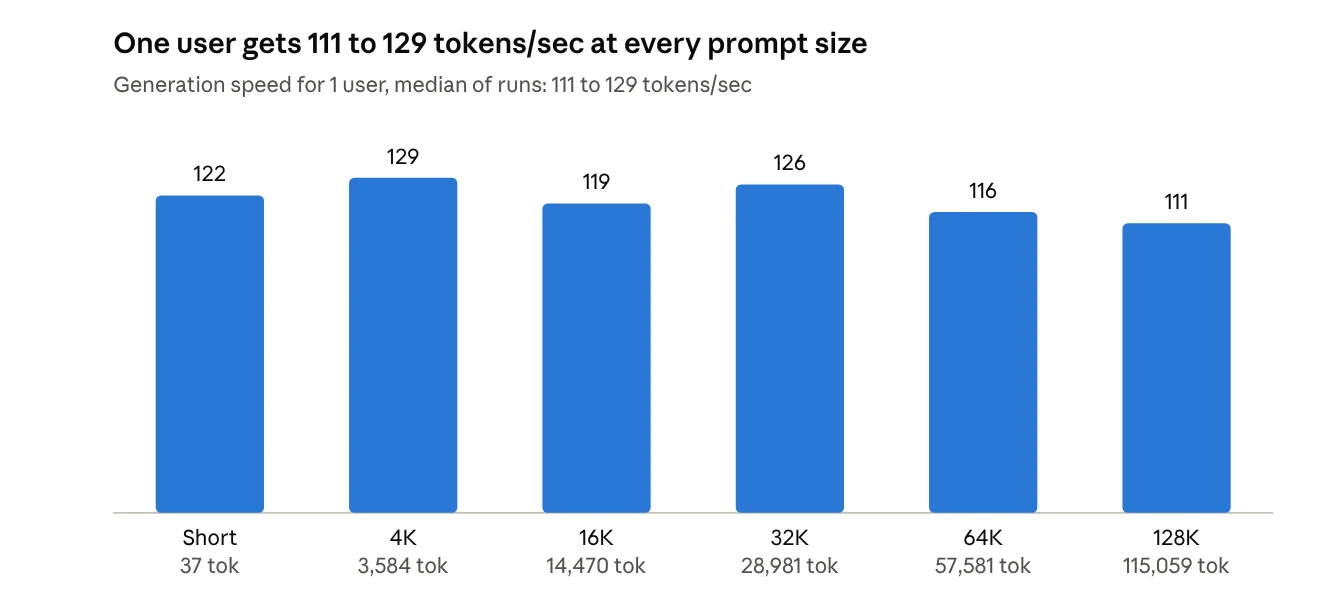
A long prompt costs time up front but no speed afterwards. The model uses about 16B of its 552B parameters per output token (vLLM recipe), which is why four 64 GB mining cards keep up.
Prompt reading
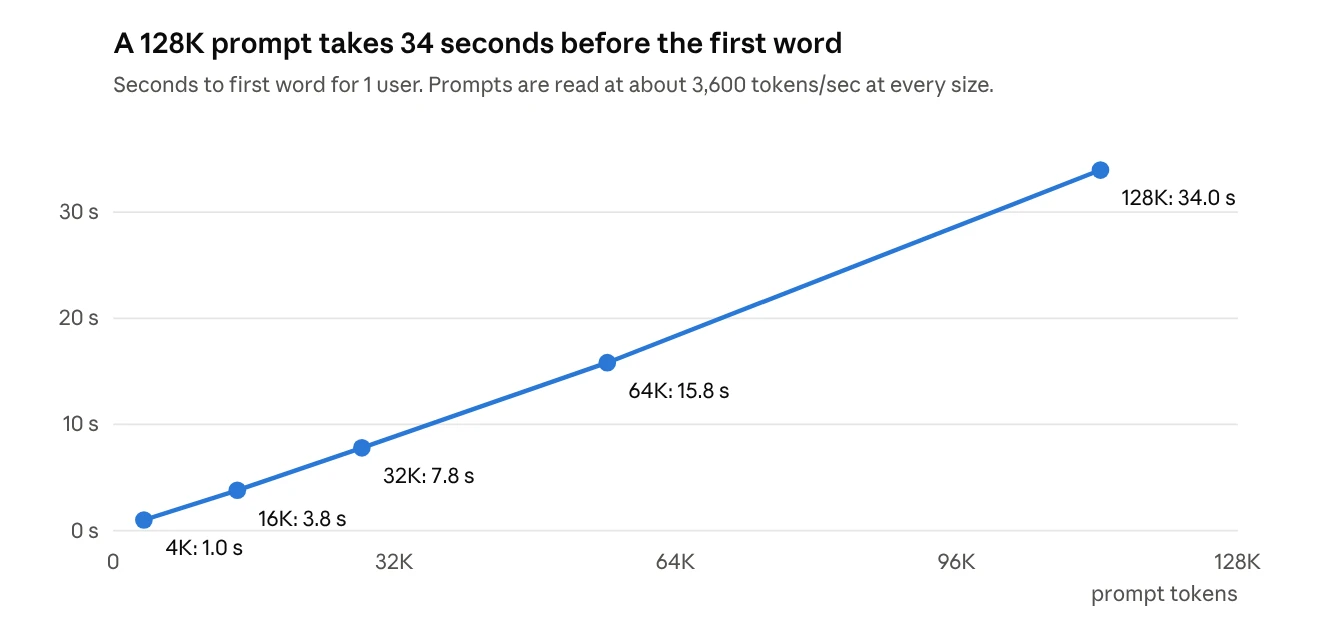
The wait grows in a straight line, about 0.28 seconds per 1,000 prompt tokens. Reading speed slips only at 128K (3,387 tokens/sec, against 3,600 to 3,800 below it).
Several users at once
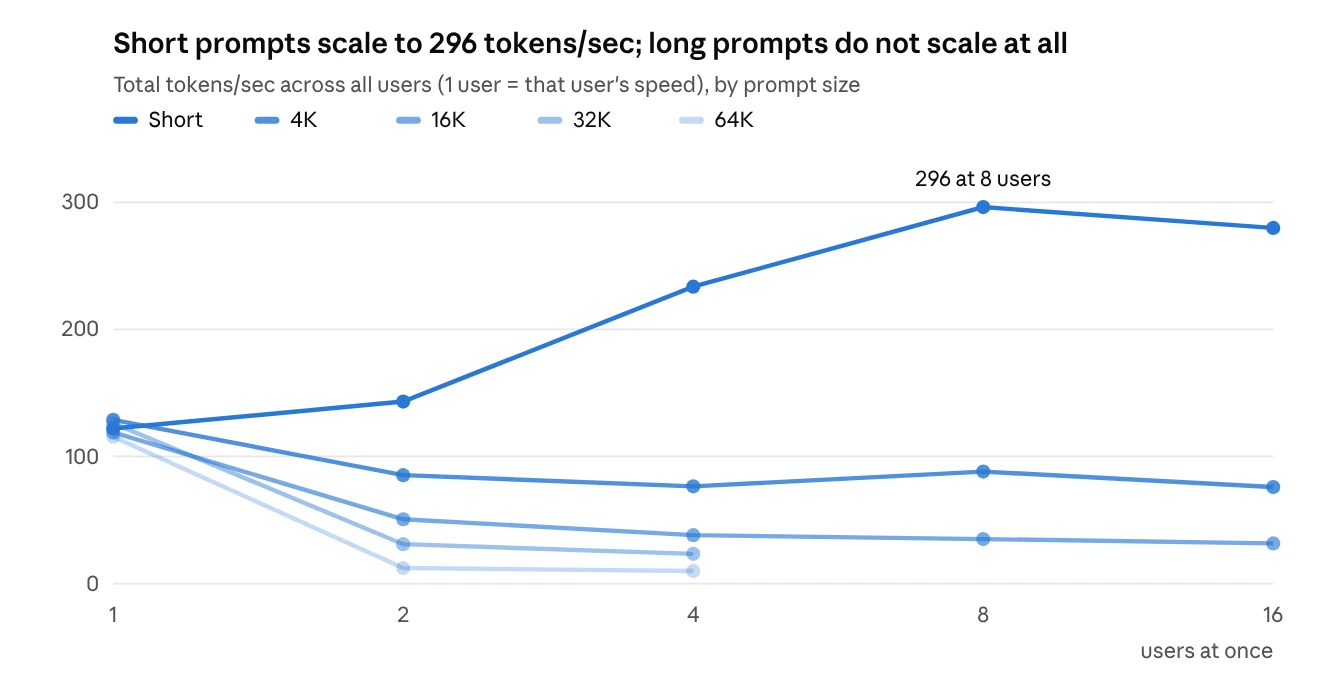
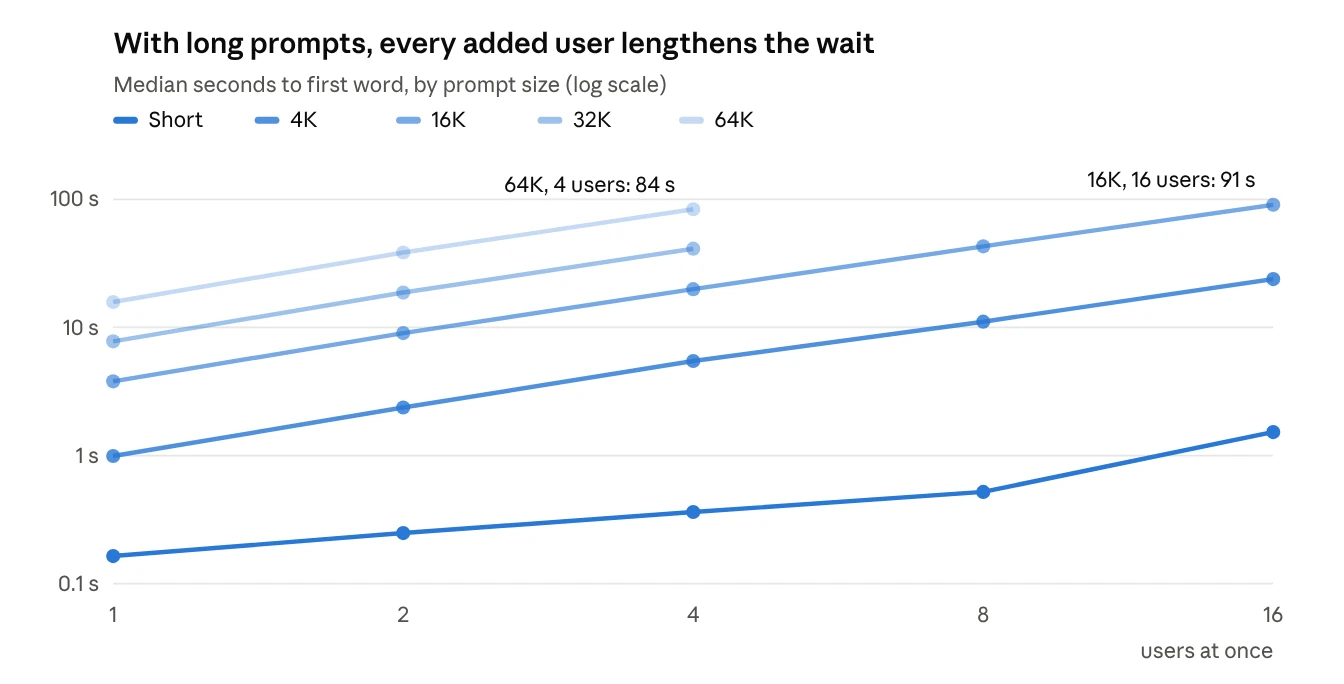
All users share one prompt reader of about 3,600 tokens/sec, fed 2,048 tokens per step. Sixteen 4K prompts are 57,000 tokens to read, so the cards spend most steps reading instead of writing, and total output stays near 80 tokens/sec. At 16 users, 8 requests also queue for a free slot. Short prompts avoid both: at 8 users the box writes 296 tokens/sec and each user still sees 46.
Quality
This quantized build answers well with thinking off: 96% on grade-school math and 86% on MMLU-Pro. Every test was zero-shot at temperature 0, so compare it with other machines run the same way, not with leaderboards.
| Test | Questions | Strict | Loose | Cut off at 2,048 tokens |
|---|---|---|---|---|
| GSM8K math | 200 | 96.0% (192) | 96.0% | 0 |
| MMLU-Pro knowledge, 14 subjects | 200 | 86.0% (172) | 86.5% | 5 |
| IFEval following instructions | 100 | 85.0% of prompts, 90.5% of rules | 87.0% of prompts | 1 |
| Long context, 8K / 32K / 128K | 21 | 76.2% (16) | 100% (21) | 0 |
- Long context: needle and multi-key lookups were perfect at every size, 128K included. The five strict misses are all variable-chain answers with the right values, listed one per line or with commas instead of the format the checker wants.
- MMLU-Pro by subject: weakest were engineering (10/16), psychology (8/13) and law (14/18); biology, history, philosophy and computer science were perfect. With 6 to 23 questions per subject, treat these as hints, not rankings.
- Cut off: six answers hit the 2,048-token cap. Raising
Q_TOKENSwould recover a point or two.
Takeaways and next steps
Four mining cards run a 552B-parameter model at over 110 tokens/sec for one user, at any prompt length up to 128K. The limit is shared prompt reading: once a second user with a 4K+ prompt joins, each person waits longer and total output does not rise.
- Try a tuning pass for long-prompt concurrency: raise
--max-num-batched-tokensfrom 2,048 to 8,192 or 16,384, then re-run./scripts/head-to-head.sh speedto compare. Watch host RAM: only 32 GB is free with the Engram tables loaded. - Mac Studio side: raced head to head on 11 November, written up as DeepSeek V4.1 Flash Head to Head: 4x CMP 170HX vs Mac Studio M5 Ultra.
- More tests: a multi-turn agent test and a cache-reuse test, which LLM-Super-Bench does not have yet.
Related: DeepSeek V4.1 Flash Head to Head: 4x CMP 170HX vs Mac Studio M5 Ultra · Four CMP 170HX Cards, One Server: 256GB of VRAM · Same Model, Three Engines: vLLM Puts the CMP 170HX Ahead · Race Your Local AI Machines and Trust the Numbers.